The Via Negativa is the best way to approach religious language. Discuss [40]

Whether this claim is valid or not very much depends on the concept of God in question.  If God is inside time, everlasting but personal – as the God of Abraham and Isaac in the Bible seems to be – then using religious language in a positive and univocal way seems reasonable.  On the other hand, if God is eternal outside time – as the God of the Philosophers, the Prime Mover, “that than which nothing greater can be conceived of” seems to be – then using words coined to describe things within time seems more problematic.  Maimonides, the most famous proponent of the Via Negativa, was heavily influenced by the Philosophy of Plato and Aristotle and so saw God as eternal outside time.  Given this, his claim in the “Guide for the Perplexed” that… “To give a full explanation of the mystic passages of the Bible is contrary to the law and to reason… God cannot be compared to anything…” and his proposal that the most that can be said about God is what God is not i.e. God is not limited, evil, something physical etc… seems persuasive.  Nevertheless, Maimonides’ Via Negativa, his apophatic way of approaching God leaves religion in a difficult position.  Religions make positive claims about God; the Holy Books and doctrines of all religions are full of them!  Maimonides’ approach makes religion die the death of a thousand qualifications.  Believers need to have something positive to fix their faith on, not silence, the empty space left by negations and a lot of small print saying that Holy Texts can’t be understood to mean what they say.  The Via Negativa – for all its logical appeal and for all its possibilities in terms of framing that language of spirituality and personal faith – is far from being the best approach to religious language. 

In a sense, Christianity is defined by the Nicene Creed:

We believe in one God,
the Father, the Almighty,
maker of heaven and earth,
of all that is, seen and unseen. 

We believe in one Lord, Jesus Christ,
the only Son of God…”

Approaching the Creed from the Via Negativa is problematic.  Admittedly, it doesn’t start too badly.  One God.  Oneness is a quality being positively ascribed to God.  Is oneness a concept bound by time and space?  Arguably.  Maimonides might replace this line with “We believe in a God who is not many…” but the sense is very much the same.  Nevertheless, things quickly go downhill.  We believe in God “the Father”… clearly “Father” is a word rooted in time and space.  Maimonides – along with Christian proponents of the Via Negativa such as Tertullian, St Cyril of Jerusalem and Pseudo-Dionysus – might have to admit that the word has no positive meaning when applied to God and worse, that it is likely to be positively misleading about His nature.  While St Cyril’s point that believers should “candidly confess that we have not exact knowledge concerning Him…” (Catechetical Homilies), this approach is unlikely to have found favour at the Council of Nicaea or in Churches today.  The central Christian mission would be a lot more difficult if believers openly confessed that they have little idea what it is they believe in!  As Maimonides wrote “However great the exertion of our mind may be to comprehend the Divine Being or any of the ideals, we find a screen and partition between God and us.” (Guide for the Perplexed)  This doesn’t offer people much incentive to be baptized, attend Church or read the Gospel; it pushes people towards deism or non-denominational “spirituality”.  In this way, the Via Negativa is not the best approach to religious language as it makes religion dysfunctional.  

Further, there is a better alternative to the Via Negativa in the form of Aquinas’ doctrine of Analogy.  Aquinas read Maimonides and was persuaded both by his concept of God and by his skepticism concerning the positive meaning of terms applied to God.  He strongly disagreed with the univocalism employed by scholars like St Anselm and absolutely rejected the idea that people can know and describe the nature of God sufficiently to analyze it and find necessary existence within it a priori, as proponents of the ontological arguments do.  In Summa Theologica 1:2:2 Aquinas wrote “because we do not know the essence of God, the proposition “God exists” is not self-evident to us; but needs to be demonstrated by things that are known to us…”  In Summa Theologica 1:2:3 he responded to the question “Is God a body” by making quite clear that the meaning of words applied to God can only be understood in a strictly limited and analogical sense.   Aquinas argues that words applied to God have meaning as analogies of being (1) and sometimes discusses two separate senses in which meaning should be understood; analogies of attribution (2) and analogies of proportion (3).

  1. Most importantly, God’s being is not the same as our being – he is Wholly Simple and timeless and as such has no potential.  The meaning of words applied to God have to be consistent with the mysterious, timeless nature that we know that he must have as a result of reasoning from movement, causation and contingency.  For Aquinas, when believers say that God is good they cannot understand that God is morally good, because that implies freedom and choice which are concepts which only make sense in time.  God is timeless and eternal, so His goodness can only be timeless and eternal – goodness in the sense of perfection and the fulfilment of nature only.  Hence, there is a positive sense in which attributes positively ascribed to God can have meaning; that in which they are compatible with His being or nature.
  2. In addition, the meaning of terms applied to God and to earthly things has an overlap in the way that I might say that I am healthy and my yoghurt is healthy.  Healthy is a property primarily of living creatures like me and only secondarily of foods or activities which contribute to my health.  According to John Milbank, Aquinas suggests that the primary sense of attributes such as “good” relate to God and the meaning of the word in an earthly sense is only secondary.  There IS a positive connection between the meaning of attributes applied to God and earthly things; the connection is not large but it is rationally defined.
  3. In addition, God’s unchangingly perfect and actual nature dictates that he must be 100% everything that can be ascribed to Him.  God cannot fall short, because to do so implies potential which is not compatible with God’s timeless nature.  Given this, God is the scale against which we make judgements about things in this world.  If I say “Jamie Vardy is a great footballer” I have to have an idea of what greatness means.  Vardy can only fulfil a proportion of what that idea is, because he is only one man in one time playing for one team – and he is not a rugby player, rower, artist or opera singer, all of which might be described as reflecting greatness in a different way.  The meaning of attributes ascribed to earthly things has a proportional relationship with the meaning of divine attributes.  Again, the shared meaning (analogy) is not a large one, but it can be rationally described.

Aquinas’ analogical approach to religious language is a much better approach to religious language than the Via Negativa because it enables believers to use and defend the meaning of positive claims about God, while not supporting naïve univocalism or a philosophically unsatisfying and ultimately limited concept of God.  Aquinas’ model of God is deeply appealing in that it is supported by real experience, but it also retains the “otherness” and unlimited idea of God that is so important to believers.  Aquinas’ theory of religious language completes his model of God because it shows how believers are worshipping in an ultimately meaningful way, even though God is beyond ordinary understanding.  The Via Negativa is not the best approach to religious language because Analogy is a much better approach. 

Scholars who employ cataphatic theology and approach religious language through the Via Positiva reject the Via Negativa on the grounds that it ignores the important connection between God – the creator – and the world – the creation.  In the same way that Philosophers reason from movement, causation, contingency, grades of perfection in things, order and purpose to the existence of a necessary being who explains these qualities we experience in the universe, people should be able to apply words based on qualities we experience in the universe to the God who created them.  Anselm and John Duns Scotus both defended the univocal use of religious language on these grounds, arguing that words refer to concepts which depend on God to define them through His creation.  Anselm’s ontological argument depends on this argument, because it analyses the definition of God and finds necessary existence within it.  This could not work if the word “greater” meant anything different when applied to God than it does when applied to things in this world.  The problem with the univocal approach to religious language is that the type of connection between creator and creation does not support a literal approach to the meaning of language.  When a person creates something, their creation does not have to be like them.  The potter is not made of clay and a skilled potter is capable of making a bad pot. We have no reason to believe that words apply to God in exactly or even much the same way as they apply to things in this world.  Aquinas strict limitations on the sense in which meaning should be understood when words are applied to God seems much more realistic in relation to a God whose relationship with the world is understood to be the creator, Prime Mover, uncaused cause, necessary being, supreme perfection and intelligent designer.   Because of this, the Via Negativa is a better way to approach religious language than the Via Positiva, but it is still less good than Analogy.

Certainly, the Via Negativa has its uses, but these are more apparent when it comes to Philosophy or the practice of personal spirituality than they are in the practice of religion.  The word “religion” refers to what binds us as people together; the ties that bind need to be clearly defined and understood if they are to function and endure. In terms of Philosophy, approaching the nature of God through negation is an important check in naïve literalism.  As Maimonides wrote “it is of great advantage that man should know his station, and not imagine that the whole universe exists only for him.”  For philosophers, it is all too easy to move from saying that there are absolute limits to human knowledge to ignoring what lies beyond those limits to denying that there is anything beyond those limits to denying that there are limits.  As philosophers and as individuals, reflecting on the nature of God as “wholly other” forces us to confront the falsity of the prevalent assumption that “man is the measure of all things” and deepen their spiritual understanding, which includes confronting limitation and embracing humility.  As Tertullian said “our very incapacity of fully grasping Him affords us the idea of what He really is…”  and as St Cyril said “in what concerns God to confess our ignorance is the best knowledge…”  Certainly, the Via Negativa is a useful brake on naive literalism and a spiritual tool for individuals, but it cannot be described as the best approach to religious language in general.

In conclusion, the Via Negativa is far from being the best approach to religious language, although it is still useful in some ways. The best approach seems to be Aquinas’ doctrine of Analogy, which treads the line between acknowledging the otherness of God and retaining the ability to say some meaningful things about God successfully.  Ian Ramsey’s suggestion that words being used in an analogical sense should be signposted or qualified in some way seems a sensible way of improving Aquinas’ analogy further, avoiding the probability that believers could miss the careful sense in which words are being applied to God and confuse religious language with ordinary language.  Thomist scholars such as Gerry Hughes SJ use the word “timelessly” as such a qualifier, showing that words such as “good” should not be taken to mean more than can be defended in relation to the being and attributes of God and as proportional to His qualities.


No true Christian could embrace Marxism! Discuss [40]

Clearly, the question is a controversial one and any response to it will depend on the definition of “true Christian” adopted and, to a lesser extent, on the working definition of Marxism, because the ideas of Marx and those of writers and politicians described as “Marxist” do not always coincide.  By way of illustration, for a Roman Catholic, obedience to the teachings of the magisterium is of primary importance in defining a “true Christian”, whereas for a Quaker individual conscience and relationship with the Spirit would be the defining factor.  For the purposes of this essay a “true Christian” will be understood to mean any member of a Church which accepts the Nicene Creed and the discussion will be limited to the compatibility between Christianity so-defined and the ideas of Marx himself.

The question of whether Christians can and should embrace Marxism is an extremely important one at the present time.  Although there have been debates about the potential compatibility of Christianity and Marxism since the 19th Century, the development of Liberation Theology – and in particular its confrontations with the Roman Catholic Church in 1984 and 1986 – brought has brought the question particular currency.  Furthermore, since 2014 Pope Francis has been giving clear signals that he would like to bring Liberation Theology back within the framework of the mainstream Church.  He has even been labelled a Marxist by some critics because of this and other related actions.  This has caused Christians to reflect on how Christianity should relate to Capitalism and to Marxism in the 21st Century world.  Should Christians be on the side of the free-market and accept the pursuit of profit as the main aim of human life?  Alternatively, should Christians be willing to engage with Marxism – for all its atheism – because its social analysis seems in tune with the New Testament and its message for the poor, alienated and exploited is one with some similarities to that promoted by the Church?  In the end the evidence points towards it being appropriate for “true Christians” to engage with Marxism, although they would have to stop short of becoming Marxist because to do so would necessitate atheism and a rejection of objective Truth, both of which would make “true” Christian faith redundant.

The New Testament contains many references which demonstrate similarities between both Jesus’ teaching and the practice of the Early Church and Marxism.  Firstly, through the Sermon on the Mount Jesus preaches a revolution.  The Beatitudes in Matthew 5 predict that all those groups who have been alienated and exploited by 1st Century Jewish society – the meek, the humble, the bereaved and the poor in spirit – would go on to inherit the earth in a new age.  Marx also preached a revolution, predicting that Capitalism would collapse and that the poor proletariat – alienated and oppressed by Capitalism – would rise up and seize control.   Secondly, through his encounter with the Rich Young Man in Mark 10, Jesus taught that the rich should share their wealth with the poor, seeing private property and privilege not as a right but as an opportunity to improve society as a whole and the lives of the poor in particular.  Jesus’ parable of the Rich Man and Lazarus in Luke 16 makes a similar point; the situations of the two men will one day be reversed and rich people will pay the price if they failed to share when they could.  Marx’s mantra “from each according to their ability, to each according to their need” seems to fit in with Jesus’ teaching perfectly… the rich (and talented) have the ability to contribute more than the poor and the poor have more need than the rich.  Thirdly, the Book of Acts Chapter 4-5 tells how the Early Church tried to put Jesus’ teaching into practice by implementing what Engels recognized as an early form of Communism.  Ananias and Sapphira were struck down by God for holding property back from the common pool, for not giving all they could have and for taking more than they strictly needed.  While Marx would have seen the idea of divine punishment as superstitious, he would have supported the moral of the story, that people who cheat and deceive for personal advantage should be subject to justice even to the point of forfeiting their lives. In short, Jesus’ ethical teaching seems to foreshadow much of Marx’s thinking and in this way it would appear that “true Christians” should be able to embrace at least the ethical element of Marxism.  

Further, many Christians – practicing members of mainstream Churches which use the Nicene Creed – have engaged with Marxism.  Thomas Hagerty was a Catholic Priest who was inspired to champion workers’ rights in 1890’s America because of his reading of Marx as well as the New Testament.  Martin Luther King was inspired by his reading of Marx and agreed with much of Marx’s analysis of Capitalism and society, although he stopped short of embracing Marxism because of its opposition to religion and its rejection of the idea of objective Truth.  More recently, Liberation Theology has brought together many Christians who have engaged with Marxism and some who are fully Marxists. In the 1980s and 1990s Jose Porfirio Miranda expressed the similarities between Jesus’ teaching and Marx’s analysis of Capitalism and society in books such as “Marx and the Bible” (1971).  Leonardo and Clovis Boff have been positive about Marxism, emphasizing the practical usefulness of Marxist analysis and revolutionary techniques and the common end of improving the conditions of the poor in “Introducing Liberation Theology” (1987).   The fact that many Christians, including ordained Catholic Priests, have embraced Marxism to some extent does lend support to the thesis, that true Christians can engage with Marxism.

Nevertheless, just because some true Christians have embraced Marxism does not mean that they should.  As one example, Gustavo Guttierez has been increasingly cautious.  While in 1974 he wrote “contemporary theology does in fact find itself in direct and fruitful confrontation with Marxism”  (A Theology of Liberation, page 53) in 1990 (after the 1984 condemnation of Liberation Theology issued by the Congregation of the Doctrine of the Faith) he stated that “at  no time either explicitly or implicitly have I suggested a dialogue with Marxism with a view to possible “synthesis” or to accepting one aspect while leaving others aside” (The Truth Shall Make you Free, page 63) “True Christians” have been less and less willing to speak about their approval of Marxism since the Roman Catholic Church voiced its opposition to Liberation Theology in the 1980s and it is probably fair to say that engaging with Marxism is unlikely to be a positive career move in some Churches.

Nevertheless, there is a difference between saying that “no member of the Roman Catholic Church can embrace Marxism!” and saying that “no true Christian can embrace Marxism!”  The fact that there were political reasons behind John Paul II’s denunciation of Marxism is obvious; 1984 and 1986 were at the height of the Cold War, during the Reagan administration.  The Church was under considerable political pressure to support US foreign policy and there was a real need to put distance between the Church and Communist regimes which were murdering Priests and outlawing Church attendance because they embraced Marx’s call for “the abolition of religion” (Deutsch-Franzosische Jahrbucher) on the grounds that it is a tool of oppression which he famously likened to opium. As so often happens, “my enemy’s enemy” became a friend; the Cold War made developed the unlikely association between Christianity and Free-Market Capitalism.  While proponents of Prosperity Theology such as Creflo Dollar might argue that Christianity is perfectly compatible with deregulated markets and right-wing libertarian government, in fact this approach is not supported by a faithful reading of the New Testament. While the Old Testament certainly teaches (in places) that wealth is a blessing from God and a sign of His favour, Jesus explicitly rejected these teachings through both his words and his actions on numerous occasions.  Jesus willingly touched lepers (making himself spiritually impure – not something anybody, let alone anybody wealthy would do) and washed the feet of his disciples (the work of a slave).  Jesus said that “it is easier for a camel to go through the eye of a needle than for someone who is rich to enter the kingdom of God.” (Matthew 19) and said that people need to be like little children, as unconcerned about possessions as the birds of the air or the lilies of the field, to have a hope of entering heaven.  Whether or not Liberation Theologians are right to embrace Marxism in developing their “hermeneutic of suspicion”, they are right that rich people get short shrift in the New Testament and are generally cast as sinners.  It seems that engagement between “true Christians” and Marxism is unwise for reasons that are more political than ideological and that there is potential for fruitful discussions between Theologians and Marxists in the future, now that the political landscape has changed somewhat. 

Certainly, Pope Francis has suggested – both in words and deeds – that there is a future for engagement with Marxism.  In 2014 the Pope welcomed Gustavo Guttierez to the Vatican for meetings and Leonardo Boff has been a vocal supporter of Pope Francis, his encyclicals and actions.  Pope Francis has renewed the commitment of the Church to social justice and has been outspoken in his criticisms of Capitalism, speaking of how it alienates people and how it exploits the poor.  It is quite obvious that Pope Francis was affected by his experience working as a Bishop and previously a Jesuit in South America, the heartland of Liberation Theology.  This point has not been lost on Pope Francis’ critics.  John Finnis and Germain Grisez, leading conservative scholars of Natural Law, wrote an open letter to Pope Francis in 2016 criticizing steps he had taken to make the Church more forgiving and inclusive.  More recently, several Cardinals and Bishops have co-signed a letter calling for Pope Francis to stop trying to reform the Church, to stop shifting its emphasis towards providing the “preferential option for the poor” that was the basis for Catholic Social Teaching through the 1960s and 70s, but which had been lost somewhat in the 1980s and 90s. Pope Francis’ encyclical Evangelii Gaudiam affirmed that “Without the preferential option for the poor, ‘the proclamation of the Gospel … risks being misunderstood or submerged’.”  He sees improving the lot of the poor in this life as central to doing Christ’s work – and this would suggest that True Christians should at least engage with Marxism to this end – but other Christians disagree most strongly. 

Not least among these critics, who have a different vision of “true Christianity” would be Protestant Evangelical Churches.  Inspired by the teachings of Luther and Calvin, many Evangelicals believe that people are justified by faith alone and that the most important part of Christianity is spreading Jesus’ message of salvation and baptizing people so as to give them the prospect of a better life after death.  Protestants might think that there is less need to improve the conditions of the poor in this life, because this life is only a temporary preparation for an eternal reward (or punishment).  Without Purgatory, for which there is little scriptural foundation, Protestants focus on the saving power of faith and the need for God’s grace; people don’t save people, God does. It is interesting that Evangelical Churches are growing quickly in South America, in part because of support they are receiving from Churches and sometimes government agencies in the USA.  In 2006 in the National Catholic Reporter, John Allen recorded that “Latin American Protestants shot up from 50,000 in 1900 to 64 million in 2000… with Pentecostal and charismatic churches making up three-quarters of this number.”  It is probably fair to say that the shift towards Protestantism in the heartlands of Liberation Theology will, in time, affect the numbers of Christians who would agree that “no true Christian could embrace Marxism!”

In conclusion, it is appropriate for “true Christians” to engage with Marxism, although they would have to stop short of becoming Marxist because to do so would necessitate atheism and a rejection of objective Truth, both of which would make “true” Christian faith redundant.  The evidence from the New Testament, history and the teaching of Pope Francis all support this conclusion, although it would be roundly rejected by some Protestants, who have a very different vision for what “true Christianity” is about.   Perhaps the most important reason for engaging with Marxism is that it caused Christians to re-examine and consider Jesus’ teaching on wealth and poverty and to think again about what He meant by the Kingdom of God.  In the 21st Century it is easy and convenient to focus on the epistles with their occasional references to a purely spiritual afterlife and ignore the overwhelming number of references to a renewal of this world in the Gospels.  Perhaps we choose to ignore the Gospels because they are demanding of us, collectively as well as individually.  Jesus undoubtedly called for practical action (orthopraxy) as well as the right words (orthodoxy), for believers to give materially as well as spiritually and to build a better this-world in preparation for the second-coming.  He asked a lot of us and most of us fall well short.  It is easier and more convenient to ignore demands we feel that we can’t meet, but that doesn’t make it right to do so. Perhaps, in the end, “true Christians” should go further than engaging with Marxism and start engaging with Jesus’ words and example. That might start a real revolution!

“Augustine’s theory of Original Sin has no place in the 21st Century world” Discuss (40)

Original sin is increasingly unpalatable in the 21st century world.  The idea that human nature is sinful to the extent that even new babies are in need of salvation and liable to go to hell if unbaptized is difficult to accept in a western, secular society which idealizes childhood, its purity and its innocence. In addition, the number of unbaptized infants who die seems to be increasing with the development of IVF, the rising world-wide use of abortofascient contraceptives and abortions as well as with fewer parents choosing to baptize their children.  Those educated in liberal societies are less and less willing to accept that a God who exacts justice through the fires of hell could be considered good.  Arguably, original sin is even more difficult to accept in parts of the world where infant mortality of a more traditional sort remains stubbornly high.  What Priest would relish informing a bereaved mother that the eternal fate of her unbaptized child is in question?  Muslims have no concept of original sin, so it is easy to see why Christians in Africa would be as likely to want to agree with the title statement as Christians in the UK would be.  The Roman Catholic Church acknowledged the difficulties with original sin in 2007, the International Theological Commission issuing THE HOPE OF SALVATION FOR INFANTS WHO DIE WITHOUT BEING BAPTISED which was widely interpreted as the Church stepping back from original sin so are as it was able to without undermining previous doctrine and the idea of infallibility. Clearly, St. Augustine has an important place in the 21st Century world.  New books about his life and work are published every year, university courses are devoted to his ideas and his work continues to be enshrined in the doctrine of the Roman Catholic Church.  Augustine is one of the four original Latin Doctors of the Church – the Doctor of Grace.  Further, Augustine’s theology is enshrined within the doctrines of Protestant Churches following Luther and Calvin, who were inspired by his teaching on grace and justification through faith alone.  Given that St Augustine has an undeniably important place in the 21st Century world, the statement must be understood to refer to the place original sin has within the thinking of St Augustine.  Is it possible to argue that Augustine’s theology could work without original sin?  Unfortunately, it is not possible and original sin continues to be important, however distasteful some of its implications might be in the 21st century world.

St. Augustine argued that human nature is sinful. In his Confessions, he described how even babies have sinful natures, which show themselves when they have to share their milk. “I myself have seen and known an infant to be jealous though it could not speak. It became pale, and cast bitter looks on its foster-brother… may this be taken for innocence, that when the fountain of milk is flowing fresh and abundant, one who has need should not be allowed to share it, though needing that nourishment to sustain life? Yet we look leniently on these things, not because they are not faults, nor because the faults are small, but because they will vanish as age increases. For although you may allow these things now, you could not bear them with equanimity if found in an older person.” Confessions 1/7:11  This might suggest that sin is part of our god-given natures, but Augustine cannot allow that sin is God’s fault or a necessary part of His creation.  To do so would be to suggest that God is either limited in goodness or limited in power, neither of which would be compatible with Christian faith.  Instead of limiting God, Augustine argued that sin is our human fault; we choose to misuse our free-will and put self-love (cupiditas) ahead of generous love (caritas), falling into sin and earning just punishment from God. For Augustine, we do this both individually and as a human race.  Without original sin, free-will offers an inadequate defence of God’s omnipotence and goodness, given that children suffer as a result of natural evil just as much (or even more) than do adults and don’t seem to deserve punishment on account of their own choices.  Adam chose to betray God, stupidly putting his self-love ahead of the generous love he should have had for mankind and for God.  All people were “seminally present” in Adam, so humanity collectively turned away from God at the Fall.  Following from this, even the tiniest infant deserves all the suffering it might experience because it inherits sin from Adam and cannot deserve grace without salvation through Christ’s atoning sacrifice. Original sin enables Augustine to side-step the problem of innocent suffering by arguing that there is no such thing as innocent suffering.  Without original sin, Augustine would have to fall back on the idea that innocent suffering can be justified, whether through the learning opportunities and growth it might afford (Irenaeus, Hick) or by being offset by the beauty and goodness it enables (Aquinas).  Any attempt to justify innocent suffering by appealing to the ends it serves is distasteful however.  As Kant pointed out, reason demands that we treat humanity “always as an end in itself and never as a means to an end“.  Can we hold God to a lower standard?  Could a God who allows appealing child-cancer as a means to an end, however great that end might be, be a good God?  Still less could that God be good when we consider that He is also all-powerful and so might reasonably be able to create a world in which the innocent suffering is unnecessary even as a means to the end. Without original sin, there would be no way to defend an omnipotent omnibenevolent God against charges of allowing natural evil and the suffering it causes to children.

In addition, Christ’s sacrifice and the salvation it offered would be unnecessary without original sin.  If human beings are only accountable for sins they choose individually, children and any adults who managed to live a sin-free life could go to heaven without grace and without the service of the Church and its sacraments.  Augustine argued against Pelagius and his suggestion that human beings possess the power to attain their own salvation, not least because Pelagianism opens the gates of heaven to good non-Christian and makes Jesus, who clearly said “I am the way, the truth and the life.  No-one comes to the Father except through me” (John 14:6) a liar.  For Augustine as for St Paul and as for most Christians around the world today, partaking in Jesus’ atoning sacrifice is necessary for salvation.  Without original sin it is difficult to see how this could be true, as some people would be free from sin and worthy of salvation without Jesus, faith or God’s grace.  Such a position could not be compatible either with Roman Catholic Christianity, which requires faith in the sacraments of the Church and their power to cleanse people of original sin… Born with a fallen human nature and tainted by original sin, children also have need of the new birth in Baptism to be freed from the power of darkness and brought into the realm of the freedom of the children of God, to which all men are called. The sheer gratuitousness of the grace of salvation is particularly manifest in infant Baptism. The Church and the parents would deny a child the priceless grace of becoming a child of God were they not to confer Baptism shortly after birth.”  Catechism 1250 Such a position could not be compatible with Protestant faith either, with its emphasis on justification through faith and the necessity of God’s grace.  As Luther wrote… “Man…does not do evil against his will… but he does it spontaneously and voluntarily. And this willingness or volition is something which he cannot in his own strength eliminate, restrain or alter.” (Luther, The Bondage of the Will, p. 102) Further, as Luther wrote in his Preface to the New Testament… “the gospel demands faith in Christ: that He has overcome for us sin, death, and hell, and thus gives us righteousness, life, and salvation not through our works, but through His own works, death, and suffering, in order that we may avail ourselves of His death and victory as though we has done it ourselves.” (Luther, Preface to the New Testament) In this respect Protestant Christian faith and Roman Catholic Christian faith concur; original sin is an undeniable part of human nature.

It is sometimes claimed that Orthodox Christians sustain a faith that is not dependent on original sin. If this was true, Orthodoxy might offer a way to agree with the title-statement and dispense with the theory of original sin.  However, while it is true that St Augustine has less prominence within the Eastern tradition of Christianity and while original sin has no place in Orthodox doctrine, it is wrong to suggest that Orthodox Christians have no concept of inherited sin or that they disagree with other Christians over either the sinfulness of human nature or the necessity of grace and salvation through the Church.  Orthodox Catechisms affirm that Orthodox Christians believe that human beings inherit sin from Adam and need God’s Grace and Christ’s salvation much as other Christians do:  “all have come of Adam since his infection by sin, and all sin themselves. As from an infected source there naturally flows an infected stream, so from a father infected with sin, and consequently mortal, there naturally proceeds a posterity infected like him with sin, and like him mortal.” Catechism of St. Philaret (Drozdov) of Moscow, 168  Orthodox Churches look to the teachings of Church Fathers such as John Cassian who taught that humans have a depraved nature and suffer from inherited sin.  Orthodox Churches also accept the writings of St Paul, on whose ideas about Adam and Christ as the new Adam in 1 Corinthians 15 Augustine based his theory of original sin.  Orthodox Christianity does not, in the end, offer a way of accepting the title statement and agreeing that original sin has no place in the 21st century world, although Orthodox Christians might not place such emphasis on Augustine as the originator of the theory of original sin.

In conclusion, St Augustine’s theory of original sin has an undeniably important place in the 21st Century world.  Although many Christians might wish is was otherwise, in practice it is not possible to sustain belief in a perfect God or the necessity of His grace and Salvation through Christ and the Church without original sin.  To put it quite clearly, if original sin has no place in the 21st Century world, then neither does Christianity.  The Roman Catholic Church has gone as far as is reasonably possible in retreating from teaching that Limbo is the certain destination of unbaptized infants and leaving their fate to the mercy of God, with whom “all things are possible” (Matthew 19:26) and whose ways human beings can scarcely understand after all (Isaiah 55:8-9).

“Religious faith requires belief in a separate soul” Discuss (40)

Assuming that the statement refers to Christian faith, through the history of Christianity there have been Christians who have believed in a separate soul (e.g. Descartes) and others who have not (e.g. St. Matthew) but the crux of the issue is whether such a belief is required.  This begs the question “by who or what standard?”  Obviously, belief in a separate soul is not required by the Creeds; the Apostles’ Creed affirms “I believe in the resurrection of the body and life everlasting” which suggests that Christian faith requires not a dualist but an avowedly monist position.  Further, the Catechism of the Roman Catholic Church 1059 affirms that “The holy Roman Church firmly believes and confesses that on the Day of Judgment all men will appear in their own bodies before Christ’s tribunal to render an account of their own deeds”.  It is clear that no belief in a separate soul can be required by orthodox Christian faith, although I will argue that belief in a separable soul might make it easier to sustain faith in the face of life’s challenges and apparent inequities.

Christian faith promises salvation; union with God and restitution for the injustices apparent in this life.  Nevertheless, the New Testament is unclear about how this salvation will come about and whether the afterlife will entail bodily existence or be purely spiritual.  The Synoptic Gospels suggest an immanent eschatology; descriptions of heaven and hell are earth-like and seem to suggest that people will have resurrected bodies to experience reward or punishment much as we experience these in the coming Kingdom of God.  Matthew 25 (the Parable of the Sheep and the Goats) suggests that the evangelists expected that Jesus will soon return to judge the living and the dead and supports a physical understanding of hell ‘Depart from me, you who are cursed, into the eternal fire prepared for the devil and his angels” (Matthew 25:41)  Luke 16:23-24 also supports this view “So he called to him, ‘Father Abraham, have pity on me and send Lazarus to dip the tip of his finger in water and cool my tongue, because I am in agony in this fire.’ Other references to the final judgement are similar “And I heard a loud voice from the throne saying, “Look! God’s dwelling place is now among the people, and he will dwell with them. They will be his people, and God himself will be with them and be their God. ‘He will wipe every tear from their eyes. There will be no more death’ or mourning or crying or pain, for the old order of things has passed away.” (Revelation 21:3-4) and this vision of the end-times seems consistent with Old Testament references, such as those in Ezekiel and Isaiah.  Christian faith supported by references in the synoptic gospels would require no belief in either a separate or a separable soul, only a belief in physical resurrection. Nevertheless, belief in physical resurrection is difficult to sustain in the modern world.  There is a complete lack of supporting evidence and it is difficult to see how it could deliver the promised reward (or punishment) in a fair and just manner.  Surely, those who died hundreds or thousands of years before the final judgement would be at greater risk of their bodes having disintegrated.  Surely, those who died as infants, after losing limbs, in extreme old-age or whose bodies were destroyed utterly would seem less likely to get their just deserts.  While “all things are possible with God” (Matthew 19:26) and Christian faith requires a belief in God’s omnipotence, it is clear that this cannot extend to God doing the logically impossible, or else most theodicies would collapse and God could not also be all-good. While God resurrecting people out of nothing by reassembling them from dispersed dust into their ideal form may not be logically impossible, it comes close to being so in some cases.

It is obvious why many 21st Century Christians prefer to believe in an eternal life, reward or punishment which begins soon after each person’s death.  A belief in immediate reward and punishment would work either with dualism, belief in a separate soul, or with a belief in re-creation into a parallel dimension.

Immediate reward or punishment through dualism, in a purely spiritual sense, is superficially easier to reconcile with science and reason.  There have been many reports of Near Death Experiences which, if credible, would to support belief in disembodied existence immediately after death.  Pam Reynolds’ experience during standstill surgery in 1991 is often seen as one of the best documented cases. More recent research conducted by Dr Sam Parnia at the University of Southampton might suggest that the soul could continue after death without a body.  In addition, a spiritual interpretation of the afterlife would be more rationally defensible than physical resurrection.  It is easier to see how a soul could survive eternally; a risen body would still be physical and so subject to aging, sickness, disability and other associated limitations.  It is easier to see how a soul could come “face to face” with God, who is not normally seen to have a physical existence as human beings do. Further, parts of John’s gospel, the Johannine letters and Paul’s letters seem to support a more spiritual interpretation of eternal life. Verses such as “So we fix our eyes not on what is seen, but on what is unseen, since what is seen is temporary, but what is unseen is eternal.” (2 Corinthians 4:18) and So then, if anyone is in Christ, he is a new creation; what is old has passed away – look, what is new has come!” (2 Corinthians 5:17) and “Whoever sows to please their flesh, from the flesh will reap destruction; whoever sows to please the Spirit, from the Spirit will reap eternal life.” (Galatians 6:8) seem obviously Platonic in their influence and are closest to dualism. However, although faith with a purely spiritual eschatology seems easier to reconcile with science and reason, it comes with significant problems and has been relatively rare through the history of Christianity. Belief in a separate soul – dualism – is difficult to defend in philosophical or scientific terms and suggests other beliefs and practices which are incompatible with Christian theology. Descartes argued for a Christian dualism, but struggled to provide a coherent account of why the soul would be enfleshed, how soul and body interact and how a disembodied soul could experience reward or punishment in the way that would be necessary for Christian promises of eternal life to be meaningful.  The Catholic Church never accepted the idea that eternal life could be purely spiritual and disembodied because this might seem to dilute the punishment of hell – annihilation or distance from God would scarcely seem a disincentive to people who have decided to commit mortal sins after all.  Further, by the Middle Ages the Church realized that dualism supports an utter contempt for the physical body, which can lead people towards extreme and unhealthy asceticism or towards a disregard for the sins of the body and the belief that its sins – sexual sins included – are less significant.

Belief that the body can be re-created in a parallel dimension after death to receive reward or punishment is far preferable.  Seeking a middle-way between the difficulties of basing faith on a future physical resurrection and basing it on dualism and a purely spiritual eternal life, St Thomas Aquinas developed his Theology on the basis of Aristotle’s Philosophy.  Rejecting the dualism proposed by his teacher Plato, in his Metaphysics, Aristotle had set out how all beings have four different types of cause; material causes (physical ingredients), efficient causes (agents), formal cause (what makes something what it is, its definition) and a final cause (the purpose or end to which its existence pertains). Aristotle understood that the soul is the formal cause of the human being, what makes it what it is and defines its existence.  Unlike Plato however, Aristotle did not see the form of a being having any separate metaphysical existence.  The form depends on the materials it specifies, and the end towards which it works.  The soul is, in effect, the function of the body – what Gilbert Ryle later described as “the ghost in the machine” – it gives the impression of being a separate entity but in fact it depends entirely on the physical body for its existence. This is where Aquinas departed from Aristotle; he argued that on death the body is re-created in a parallel heavenly dimension and that the new unity of soul and heavenly body is subject to punishment and reward.  Arguably, this idea of re-creation has a basis in scripture; references such as “They are buried as natural human bodies, but they will be raised as spiritual bodies.” (1 Corinthians 15:42-44) can be interpreted as Biblical support for Aquinas’ “modified dualism”.  Further, John Hick developed a defense of re-creation into a parallel dimension through the “replica theory” which he developed in Death and Eternal Life (1976).  As Hick argued, provided that the replica retains the memories of the original, difficulties with spatio-temporal continuity can be overcome.  When Captain Kirk said “beam me up Scotty!” there was no doubt that Kirk remained Kirk although there was a break in his spatio-temporal existence. Aquinas’ theory of re-creation supports Christian faith far better than either monism and physical resurrection or dualism and purely spiritual reward/punishment.  It avoids both the challenges presented by science and reason to belief in physical resurrection and the theological pitfalls of dualism, while straining credulity to a lesser extent because it requires only that the soul could be briefly separable, not that it must be sustained in a separate state.  For this reason, Aquinas’ theory was adopted into the doctrine of the Roman Catholic Church at the Council of Trent in the 16th Century.

In conclusion, it is clear that orthodox Christian faith does not require belief in a separate soul.  Christian faith can be sustained through a belief in physical resurrection, either in the future starting with the final judgement as the Synoptic Gospels, Creeds and Catechism suggest, or through re-creation into a new body in a parallel dimension as St Thomas Aquinas suggested.  Re-creation does not require belief in a separate soul, but does suppose that the soul is separable.

“Religion will have no place in 22nd Century Britain!” Discuss (40)

Religion is in decline in 21st Century Britain. This does not seem to be due to an increase in peoples’ understanding of science and acceptance of it as a complete explanation for life.  As Richard Dawkins has observed, even non-religious people remain wedded to unscientific beliefs and the battle for science and reason is a long way from being won, even in Britain which is one of the most secular countries in the world. In a “post-truth” era, people are increasingly willing to question scientific method and accept “alternative facts” on the strength of little more than popular opinion or convenience. Further, there is no clear correlation between supernatural beliefs and religiosity in Britain.  For examples, a YouGov poll in 2017 suggests that only 19% of British Christians have any difficulty accepting the Theory of Evolution through Natural Selection as a full explanation for human life and a YouGov poll in 2015 suggested that only 55% of self-identifying Christians actually believe in God!  Clearly, some people claim religious affiliation and even attend a place of worship, while not subscribing to the most basic doctrines of that religion.  Further, it is probably fair to say that a lot of people who do not attend a place of worship maintain religious beliefs.  Nevertheless, NatCen’s Social Attitudes Survey of September 2017 made headlines when it reported that 53% – a majority – of the British public now describe themselves as having “no religion”, up from 48% in 2015 and 31% in 1983.  From a straightforward statistical perspective, it would probably be fair to say that Religion will have a much smaller place in 22nd Century Britain than it does in 21st Century Britain. 

Of course, statistics do not provide a complete picture; they need to be contextualized and interpreted, as well as to be tested for validity.

Firstly, it is wrong to infer that because the number of people with a particular characteristic in a society is small that that characteristic “has no place” in society.  Consider; the percentage of people who identify as transgender or even homosexual in Britain is small.  Estimates suggest that around 1% of people are gender nonconforming to some extent and the 2013 ‘Integrated Household Survey’ undertaken by the Office for National Statistics found that just 1.1% said they were ‘gay’ or ‘lesbian’ and 0.4% said they were bisexual on a sample of 178,197 British adults. This suggests that there are about 545,000 homosexual and 220,000 bisexual adults in the UK but relatively few people would accept that this is evidence for gays, lesbians and bisexuals, their issues or culture, having “no place in” our society.

Secondly, the headlines of the data conceal the fact that both the religious landscape and the intensity of religiosity in Britain are changing as a result of evangelism and immigration.  The numbers of evangelical Christians, of Muslims is rising and is projected to rise further in the coming decades according to Pew Research in 2015.  Reasonable estimates suggest that the proportion of Muslims in Britain will increase towards 10% by 2050.  Further, Pew Research in 2015 suggested that Religion is very important to more Evangelical Christians and Muslims in the US than it is to members of more traditional Churches.  If the same is true in the UK, then the shift from traditional Churches towards Evangelical Churches and the increase in numbers of Muslims could signal an increase in how important religious people think religion is in their lives.  While the raw number of religious people might be much lower in the 22nd Century Britain than it is in the 21st Century Britain, these people might well see religion as more important than many religious people do today.  Possibly, the influence of religion will not decline as as sharply as the raw percentages might suggest it should.  On this basis, Religion might still have a place in 22nd Century Britain.

Thirdly, the sample size used by NatCen to gather religious affiliation and attendance data is small and its conclusions are contested.  NatCen’s surveys typically draw on fewer than 2000 responses, so the margin for error on projections of proportion across the sample would be just less than 3%, with a substantially higher margin for error on projections for age-cohorts, which are sometimes dependent on excessively small samples such as the 20 responses available for the before 1920 cohort in 2008.  Further, UK Census data suggests that the NatCen figures for religious affiliation may be significantly lower than the actual figures. For example, in 2001 NatCen suggested that 54% of the British population was Christian whereas the Census suggested 72%.  In 2011 NatCen suggested that 47% of the British population was Christian whereas the Census in the same year suggested that the figure was 59.3%.  Further, by the same comparison, NatCen seems to inflate the numbers of people who are not religious even more dramatically.  For example, in 2001 NatCen suggested that 41% of British people were not religious whereas the Census in that year suggested that the figure was just 15%.  In 2011 NatCen suggested that 46% of the British population was not religious while the Census suggested a figure of 25.1%.

Despite significant issues with the statistical evidence, it is clear that both NatCen and the Census data support the principle that religious affiliation is declining steeply and that the number of people with no religion is increasing rapidly.  Projecting forward it might be inferred that religion will have died out in Britain by the 22nd Century.  Indeed, NatCen’s figures suggest that the percentage of religious people has been falling by approximately 1% per year and that 71% of 18-24 year olds claiming to have “no religion” in 2016, compared with only 27% of those aged 75+.  Although the margin for error in these statistics is quite sizable, on this basis it might seem reasonable to argue that the % of religious people will be negligible by the mid 21st Century and that Religion will indeed have no statistical place in 22nd Century Britain.

Such a conclusion might seem to ignore the effect of age on religiosity.  It is clear that as people age they tend to become more religious.  Argue, Johnson and White documented this in the Journal for the Scientific Study of Religion back in 1999.  They stated that… “The results show a significant, non-linear increase in religiosity with age, with the greatest increase occurring between ages 18 and 30...” (Abstract)  This would make sense given analyses of Religious belief put forward by scholars from Feuerbach through Durkheim to Freud.  As Feuerbach and later Durkheim noted, Religion fulfills societal needs and seems to be projected and shaped by societies for their own purposes, such as to promote conformity or a collective moral conscience.  As Freud noted, a similar pattern applies to individuals, with religious beliefs and practices fulfilling psychological needs and desires for most people and so, arguably, being projected by the subconscious mind to quell anxiety.  If religion is a man-made phenomenon, a natural response to personal and social needs, then it would make sense for religiosity to be more apparent in older people who are more likely to have experienced the need for community, conformity and comfort.  If, as Freud suggested, God acts as a father-figure for those without a father it would make sense that belief in God would be more apparent among those who have lost their parents and are generally more lonely and isolated.  If, as Durkheim suggested, religion comes into being and is legitimated through moments of what he calls “collective effervescence” then it would make sense for older people – who are more likely to have had experience of such “moments” – to believe and belong. British Social Attitudes Graphs_001

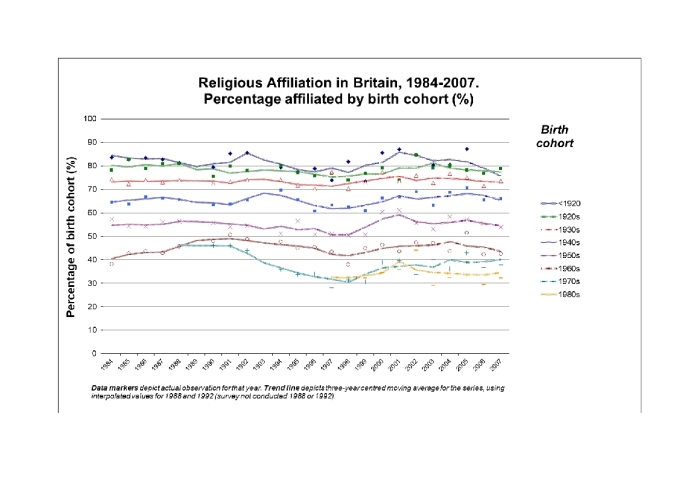
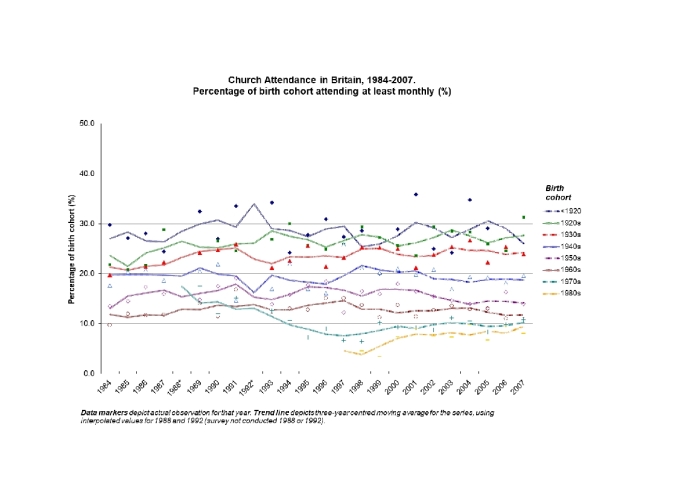
British Social Attitudes Graphs_002However, once adjusted for aging, the statistics still suggest a real and significant decline in Religious affiliation and attendance. D. Voas and A. Crockett, ‘Religion in Britain: Neither Believing nor Belonging’Sociology (2005), vol. 39, pp. 11-27 analyse British Social Attitudes by age-cohort, noting that affiliation and attendance declined markedly from cohort to cohort, but remained relatively steady in both measures across a 23 year period from 1984 to 2007 for each cohort born before 1970.  In addition, for the 1970s cohort however, affiliation declined from an average 46% in 1990 (when most of the cohort would have been teenagers) to an average 28.1% in 1997 (when most of the cohort would have been starting their careers).  Why the 1970s cohort were particularly susceptible to secularization during the 1990s is an interesting area for research, as is what the effects of this on the children of those in the 1970s cohort will be.  However, as it stands this research suggests that both on the basis of the lower rates of religious affiliation and attendance seen in successive age-cohorts through the 20th Century and into the 21st Century and on the basis of a further decline in religious affiliation and attendance seen during the 1990s within the 1970s cohort, it is reasonable to project that in the absence of other factors, religious affiliation will decline towards zero over the next century.  

Yet what might these “other factors” be and how might they still affect the place of religion in 22nd Century Britain?

One factor might be apparent in NatCen’s figures for the 1980s cohort rates of affiliation, which rose from 32.6% in 1997 (when the cohort were mostly teenagers) to a high of 39.2% in 2001, before returning to 32.3% by 2007 (when most of the cohort would have been in their 20s).  The short-lived spike in religious affiliation within the 1980s cohort around 2001 is mirrored within the 1950s and before 1920 cohorts, but was not evident in the attendance figures… apart from for the before 1920 cohort, who seem to have attended places of worship in 2001 and again in 2005 in significantly higher numbers.  It is tempting to interpret the correlation between higher church attendance among elderly people and big terrorist attacks as having some sort of causative explanation.  Going back to Feuerbach and Freud, perhaps the shock of 9/11 and 7/7 caused people to seek solace in religion?  Going back to Durkheim and thinking about Marx, perhaps the trauma of the attacks and the “war on terror” can explain the need for a collective religious response, both practically and politically.  If religion is the “opium of the masses” it would be reasonable to see more of it being used – rightly or wrongly – when the masses are in real pain!  Nevertheless, if the breakdown of the statistics is anything to go by, the statistical spike was not demographically uniform and nor did changes in affiliation rates translate into attendance.  Only the oldest people actually attended a place of worship more often in 2001 and in 2004-5; there is no apparent change in NatCen’s attendance figures for younger people and the attendance of the 1960s cohort actually dropped in that year and in 2005.  Perhaps the statistical spike in affiliation in 2001 and around 2005 is more to do with expressing solidarity, cultural and moral identity and to do with asserting hope in a seemingly hopeless situation, than it is to do with any actual change in what people believe or do in terms of religion.  In part, this seems to confirm Max Weber’s suggestion that religion emerges out of peoples’ need to respond to the injustice of evil and suffering and out of their need to believe in salvation and that something they can do could lead to a righting of this injustice.  What might the principle that people might be willing to state religious affiliation in greater numbers at times of social stress suggest about the place of religion in 22nd Century Britain?  Just that religion will probably continue to have a place in 22nd Century Britain and that then, as now, that place will be more apparent at times of national crisis and when people feel the need to assert control over their fates. 

Further, the population is aging.  This trend might be interrupted or even reversed by the reduction in antibiotic efficacy, the increase in cancers, the growing likelihood of pandemics as well as by decades of under investment in health and social care etc, but if it continues even at a slower rate, the proportion of very elderly people in the 22nd Century Britain might well be larger than it is today.  Sadly, a higher proportion of very elderly people is likely to result in a higher proportion of people suffering from poverty, loneliness, isolation and depression, all of which are indicators for higher rates of religiosity.  In “Religion and depression: a review of the literature” (1999) McCullough and Larson found that… “some forms of religious involvement might exert a protective effect against the incidence and persistence of depressive symptoms or disorders.”  Surveying more than 440 pieces of research, in “Religious and Spiritual Factors in Depression: Review and Integration of the Research” (2012) Raphael Bonelli et al found that  “Religious beliefs and practices may help people to cope better with stressful life circumstances, give meaning and hope, and surround depressed persons with a supportive community.”  According to a 2008 study, people who are lonely are more likely to become religious while rates of loneliness in the UK among older people are high and arguably rising, perhaps as a result of families dispersing and the long hours worked by British people.  These studies seem to support Freud’s suggestion that Religion can often help people to cope with voids in their lives and Jung’s suggestion that religion is about much more than a world-view or a set of rituals and is better understood as a process of working out our relationship with reality.

In addition, Gallup research in 2009 found that Religion is typically far more important to the population in poorer countries than it is in richer countries and that there is a direct correlation between economic prosperity and religiosity. If rates of religiosity in Britain have a relationship with the economy, then the place that religion has in 22nd Century Britain may depend on the long term economic future of the country.  Of course, the relationship between religion and economics was charted more than 100 years ago by Karl Marx and then by Max Weber, who both understood how religion can function as a tool of capitalism which keeps ordinary people motivated and engaged with the market and the political system which puts it first when it singularly fails to benefit them. Of course with Brexit on the immediate horizon, continuing problems with managing the deficit and the housing market, the national debt and the longer term effects of world population growth, climate change and resources depletion, it is difficult to forecast what the economy will be doing in five years time, let alone into the 22nd Century.  It could be that Capitalism will collapse before that time; Marx predicted that it will.  Suffice it to say that there is a real possibility that Britain will be poorer in the future, and that with the decline in its finances the country could see an increase in the number of people expressing religious affiliation… and even attendance (assuming that places of worship continue to function for long enough to benefit from an upturn in numbers that is).

In conclusion, the claim that religion will have no place in 22nd Century Britain is exaggerated.  While religious affiliation will probably continue to decline, part of this effect may be offset by an increase in religious intensity among those believers who are left, by temporary increases in religiosity at times of national crisis and by the probable effect of a potentially aging and in any case stressed, sick and impoverished population.  Further, even with a small proportion of religious people, there will continue to be a place for religion in British society as there are places for other minority ways of life. Clearly, the decline in religion will raise questions about the established status of the Church of England, the representation of religions in the House of Lords and about the protected status enjoyed by religions in relation to tax and education for examples.  How these questions are handled will have some effect on the place religion will have in 22nd Century Britain.


Charlotte Vardy will be proposing the motion “This house believes that religion should have no place in 22nd Century Britain” as part of Candle Conferences’ “Outstanding A Level Religious Studies” events across England during November 2017.

“Boethius proved that God’s omniscience is compatible with human free will.” Discuss (40)

Boethius’ discussion of Divine omniscience can be found in his Consolations of Philosophy, Book 5.  Facing his own death, Boethius reflects on the human condition and imagines a dialogue with Lady Philosophy, who points out the vast web of Aristotelian causation in which our lives are caught. In Part I Boethius asks…

“in this series of linked causes is there any freedom left to our will, or does the chain of fate bind also the very motions of our souls?’

pointing to a problem that has always dogged Classical Theism.  If God is Omnipotent, and if Omnipotence entails omniscience, then it is difficult to maintain any meaningful degree of human freedom.  Without freedom there seems to be no convincing way of defending God against charges of creating or at least allowing gratuitous suffering.  A God who is omniscient cannot also be benevolent.  Boethius proceeds to explore this problem and then attempts to resolve it by clarifying the very nature of God and therefore the nature of His foreknowledge, yet his resolution fails to show how Omniscience and human freedom are compatible in the end.

In Book 5 part III, Boethius sets out the paradox of omnipotence in some detail.  Drawing on Platonic philosophy, and the eternal model of God suggested to Christian Neoplatonists by the Timaeus, Boethius saw God’s eternal existence and nature as a necessary conclusion of rational reflection on a contingent world.  However, accepting God’s eternity comes with problems.  Boethius pointed out…

“if from eternity He foreknows not only what men will do, but also their designs and purposes, there can be no freedom of the will”

and explained how neither the suggestion that God’s knowledge of them makes future events necessary nor the suggestion that God’s knowledge is contingent on events in time are satisfactory.  J.M.E. McTaggart (1866–1925) differentiated between a God whose knowledge of events is from a perspective in time (A series eternity) and a God whose knowledge of events is from a perspective outside time whereby all events are simultaneous in the mind of God (B series eternity).  Boethius argued that putting God’s perspective in time, giving him A series eternity, makes God’s knowledge depend on time and the things that happen within it.  If I watch a bus arriving at its stop, my knowledge of it happening depends on the bus doing what it is doing and on time passing to facilitate what it is doing.  Clearly, in this scenario my knowledge of the bus does not determine the bus in doing what it does – I could not reasonably be held responsible for the bus being early, late or punctual – and yet it is also true that my knowledge of the future is limited because I cannot know what has not yet happened.  This sort of A series eternity fails to support the supreme knowledge and power that Classical Theists impute to God.  However there are also problems with B series eternity, as Boethius pointed out.  If God has a timeless perspective and knows all things and events simply and singly, then it seems to follow that future events happen necessarily because they are known by God before they happen and because they cannot not happen.  Consequently,

“what an upset of human affairs manifestly ensues! Vainly are rewards and punishments proposed for the good and bad, since no free and voluntary motion of the will has deserved either one or the other… And therefore neither virtue nor vice is anything, but rather good and ill desert are confounded together… Again, no ground is left for hope or prayer, since how can we hope for blessings, or pray for mercy, when every object of desire depends upon the links of an unalterable chain of causation?”

Boethius sets out how if God knows things that might not come to pass, then His knowledge is limited and if God’s knowledge depends on how things are in time, His power is limited.  He accepts that on the issue of omniscience rests the plausibility of Religion – for without genuine human freedom there can be no morality, no hope for meaningful salvation and no real communication with the Divine. In Part IV Boethius addresses this fundamental problem by attempting to show that God’s foreknowledge of events is not necessary by pointing out that God’s knowledge is not like human knowledge, and suggesting that freedom and foreknowledge could be compatible for God in a way that they do not seem to be to us. God’s knowledge, argues Boethius, is not due to physical senses, nor to imagination, nor to thought, but is instead the knowledge of pure intelligence which understands the very underpinnings of reality

“by surveying all things, so to speak, under the aspect of pure form by a single flash of intuition.” 

For Boethius,

“eternity is the possession of endless life whole and perfect at a single moment… since God abides for ever in an eternal present, His knowledge, also transcending all movement of time, dwells in the simplicity of its own changeless present, and, embracing the whole infinite sweep of the past and of the future, contemplates all that falls within its simple cognition as if it were now taking place. “ (Book 5, Part VI)

This is persuasive; St Augustine discussed something similar in The Confessions (354–430) and St. Thomas Aquinas extended and developed a very similar position in the Summa Theologica (1264).   However, the price of resolving the conflict between foreknowledge and free-will seems to push God far into timeless abstraction and seeming unknowability.  Arguably, this approach preserves the technical plausibility of Religion by sacrificing the practical plausibility of Religion and so achieves, at most, a pyrrhic victory.  Surely, it is no more meaningful to pray to “pure intelligence” – whose knowledge of individual circumstances is limited to part of a single flash of intuition unsullied by sight, imagination or thought – than it is to pray to a being who has determined the prayer, its cause and its outcome by His very existence?  Further, the meaning of the divine attributes would be severely restricted by pushing God outside the spatio-temporal framework that describes ordinary human language.  What can the words “benevolence” or “power” really mean in a timeless sense?  A timeless God cannot have choice – because choice implies a time before and after a choice is made and the possibility of things being other than they are.  A timeless God cannot act – because action implies a time before and after at the very least.  As Sir Anthony Kenny pointed out that the concept of a timeless God seems “radically incoherent.”  He wrote…

“my typing of this paper is simultaneous with the whole of eternity. Again, on this view, the great fire of Rome is simultaneous with the whole of eternity. Therefore, while I type these very words, Nero fiddles heartlessly on.” (Kenny, The God of the Philosophers (Oxford, Clarendon Press) 1979, 38–9)

The idea that a timeless God can do or be anything that is comprehensible through normal concepts and words is ridiculous.  There is no shared analogical meaning between words applied to God and the world, whatever Aquinas tried to argue.

Boethius was aware of this problem in positing a completely timeless God and tried to reconcile his claim that God exists in a timeless eternity with God having the ability to know events as they happen and a degree of freedom or openness in the future.  In Part VI he argued that while God sees events an eternal present, God’s knowledge cannot be understood to cause them to happen.  God can know an event or action that is genuinely free because his knowledge is of an eternal present rather than a future as we would understand it…  Taking the bus analogy again, God witnesses its journey like a single stack of still photographs.  Every step of the journey is known as if in the present – God’s knowledge is not constrained by time because he sees everything now, but God’s knowledge still depends on the way things are rather than making them the way that they are and removing all freedom. God’s knowledge is neither conditional (as ours usually is) nor simply necessary (as would be the case with a completely timeless God who would be unaware of any present).  God’s knowledge is unlike any form of human knowledge in that it is conditionally necessary.  The very categories “contingent” and “simply necessary” suggest temporal and logical frameworks that do not apply to God who creates these frameworks and exists outside them.  While this is persuasive, God’s conditionally necessary knowledge of events seems little more religiously satisfying than God’s timeless knowledge of events.  God’s experience of an eternal present is almost as different from human experience as a genuinely timeless experience would be.  The preservation of free will, moral responsibility and divine benevolence is by no means clear either.  If God knows future events now and they cannot be other than how they are, then whether God knows them as if in an eternal present or otherwise, it is difficult to see how anything can really change by human agency.

EL Mascall tried to suggest that quantum science could provide a model for understanding how God’s actions could both be timeless and have an appearance of being in time if each action could be conceived to have a timeless and a temporal pole which are interrelated, this does not advance the discussion by much.  Mascall is just restating the assertion that things would look different from God’s point of view in different language.  He doesn’t seem to do more explain how God can both know the future in a way that God ensures that nothing but what God knows can happen and not be responsible for what happens.  Other contemporary writers, such as Eleonore Stump, Norman Kretzmann, and Brian Leftow, have also tried to modify the timeless model of God by insisting that God’s timeless eternity has some of the features of temporal duration.  The project that Boethius started retains its interest because arguably, the plausibility of religion depends on its success.  However, the project has yet to yield conclusive results.

In addition, Protestant scholars Nelson Pike and Richard Swinburne have developed related arguments.  For Nelson Pike the idea that God’s knowledge can be that of pure intelligence taking in the whole of reality in a single flash of intuition is incompatible with the God revealed through the Bible.  The God of the Bible – of Abraham, Isaac and Jacob to borrow Pascal’s phrase – is active and responsive and seemingly possessed of the ability to see, hear, imagine, think and even feel.  In his essay “Divine Omniscience and Voluntary Action” (1965) Pike points out that whatever metaphorical interpretations are put on Biblical accounts of God wrestling Jacob or speaking with Moses or acknowledging Jesus at His Baptism, God’s knowledge is inescapably tensed.  If this is true, then it is difficult to see how Boethius model of a God experiencing an eternal present could be acceptable to people of mainstream Christian faith. A timeless model of God – even the modified timeless model proposed by Boethius – conflicts with the Biblical account of His creative action and nature.  Swinburne agreed, pointing out that…

“The God of the Hebrew Bible… is pictured as being in continual interaction with humans – humans sin, then God is angry, then humans repent, then God forgives them…” (The Coherence of Theism 2nd ed. 2016 p233)

Without the idea of God responding to human sin and human repentance, there is no obvious way to preserve what is meaningful about Christianity.  Swinburne adds that…

“The Hebrew Bible shows no knowledge of the doctrine of divine timelessness… God is represented as saying “I am the Alpha and the Omega…”  … but it seems to me to be reading far too much into such phrases to interpret them as implying the doctrine of divine timelessness.”  (Ibid. p230)

Although the ideas of God’s timelessness or eternity are philosophically useful in that they provide possible means of defending God against responsibility for suffering – including inflicting endless fiery punishment arbitrarily – the ideas find no support in Scripture and conflict with essential Christian beliefs and teachings.

There seems to be a contradiction between the Philosophical model of God suggested by Boethius, developed by Aquinas and enshrined in Catholic doctrine and the everlasting God described by the Bible and proposed by Theistic Personalists, many of whom are Protestant.  Further, neither model of God really avoids the problem of Omniscience outlined by Boethius in Book 5 of The Consolations of Philosophy.  The God of Theistic Personalists must either be limited in knowledge or power (and so is Philosophically unsatisfying) and the Timeless God is limited in terms of not being able to witness, experience, respond or act in any recognizable sense (and so is religiously unsatisfying.)  Boethius failed to prove that God’s omniscience is compatible with human free will, but he succeeded in outlining the inescapability of the problem and the importance of addressing and ultimately resolving it.  While Nelson Pike was careful to open his 1965 essay Divine Omniscience and Voluntary Action by disassociating himself from the implications of his contribution to the project Boethius started, it is difficult to ignore these implications for long.  Either God is limited (i.e. not Omnipotent, Omniscient or Benevolent) or human beings are determined… but in any case Classical Theism is incoherent.


Critically evaluate the Ontological Argument. (40)

The Ontological Argument was first so-called by Immanuel Kant, who sought to destroy the attempt to establish God’s existence a priori that had been made by Leibniz, Descartes and first by St Anselm.  In basic terms the Ontological Argument suggests that since

  • P1. God is supremely perfect

and

  • P2. Existence in reality is better than existence only in the mind
  • C.   God therefore must exist.

The argument contends that real existence is a necessary part of the concept of God and thus that attempts to deny God’s existence are foolish.  Anselm quoted Psalm 14:1 and concluded that atheists assert a straightforward contradiction, in effect saying “God (who by definition must exist) does not exist”.   While the argument seems like “a charming joke” (as Schopenhauer put it), as even the Bertrand Russell remarked, it is much more difficult to show how it fails.  Nevertheless, the Ontological Argument does fail for the reasons set out by Kant in his Critique of Pure Reason.

Kant aimed his critique at Descartes’ version of the Ontological Argument, although his points do relate to other versions as well.  Descartes developed his argument in several places, but the most well known version is in his Fifth Meditation, where he reflected that the existence of a supremely-perfect being was as undeniable and necessary as three sides are to a triangle or valleys are to hills.  Like Anselm, Descartes suggests that existence is part of the definition of God as supremely perfect (as Anselm put it “that than which nothing greater can be conceived of”).  Kant rejected this absolutely.  For Kant all knowledge claims are either synthetic or analytic.  Synthetic claims refer to experience and so add to our knowledge of the world, but they always contain the possibility of being true or false.  Analytic claims are based on logic, reason. The relationships between concepts – if valid they provide certainty, proof, but they are tautologous and do not add to our stock of knowledge, they just clarify our understanding and so provide insight.  Kant argued that the Ontological Argument analyses the concept of God and claims to find existence within it. Although it is analytic, it makes an existential claim.  Kant argues that this is impossible – all existential claims must be synthetic – and this is highly persuasive.  Analytic statements cannot expand our knowledge of what does or does not exist in the real world. As Gaunilo remarked in response to Anselm in his essay “on behalf of the fool,” it is absurd to try to define something into existence.  If somebody suggested that a perfect island exists just because by definition it has to, nobody would book tickets to go there on holiday!  Kant’s division of knowledge into synthetic and analytic is still widely accepted, as is his argument that all existential claims must be synthetic, despite WV Quine’s criticism of Kant’s understanding of knowledge.  Quine claimed that the division of all knowledge into synthetic and analytic was a “dogma of empiricism” and only true within Kant’s own limited worldview.

Kant went on to show how the Ontological Argument makes the assumption that existence is a perfection.  Both Anselm and Descartes argue that it is better, more perfect, to exist in reality (in re) than just in the mind (in intellectu) but, as Kant points out, there is no difference between the concept of a real $100 and an imaginary $100 – the concept remains the same whether the money is in my pocket or in my head.  Existence does not add a single penny to the concept, it just tells me where (and if) the concept has been actualised. Related to this is Kant’s famous observation that existence is not a predicate and that the Ontological Argument rests on poor grammar.  A predicate is a word that describes an object.  Although superficially it seems that existence adds to our knowledge of an object, in practice it is the basis on which any claims to knowledge about an object make sense.  Take a job interview.  If there are two candidates, equally well qualified, but it later emerges that only one exists it is not a case of saying that the real candidate is better than the fictitious one but it is a case of saying that the contest was a joke.  As Bertrand Russell remarked, if I ask you “has the present King of France got blonde hair and blue eyes” I smuggle the assumption that there IS a present King of France into my question.  Actually, there is no present King of France so my question is meaningless and can’t be answered either correctly or incorrectly.  This is a difficult point to deny and seems to conclusively destroy the Ontological Argument’s claim to proving God’s existence.  Although there is an intuitive human appeal to the idea that a (any?) real chocolate cake, island – or God – is better than one that only exists in the mind, in practice that cannot be sufficient basis for a claim that God exists.

Kant’s criticisms of the Ontological Argument show that it fails in its object of proving God’s existence. Of course that does not mean that God does not exist.  Just because the Ontological – or any – argument for the existence of God is found to be unsound has no effect on the existence or non-existence of God, although it does take away one support for Propositional faith.  Is it fair to say that as a failed argument the Ontological Argument really is a “charming joke” then?  Absolutely not.  Anselm originally titled the Proslogion “Fides quaerens intellectum”; in the process of faith seeking understanding the Ontological Argument succeeds in clarifying our understanding of the nature and limits of human knowledge.  As such, the argument continues to have great significance.  Further, as both Karl Barth and Iris Murdoch suggested, the argument invites believers to reconsider what they mean by existence, particularly when it comes to God.  Do believers really expect God to be real in the way that a perfect island might be real, or do they have a different sort of reality in mind?

Critically evaluate the Kalam Argument. (40)

The Kalam Argument for the existence of God was put forward by Islamic mutakallimimiin in the early middle ages. Responding to the work of Aristotle, gathered and translated by the first Caliphs into the Bayt al Hikmah in Baghdad, Muslim scholars were divided between accepting Aristotle’s persuasive world-view along with his arguments and modifying Aristotle to fit in with the revealed truth that the Universe was created by Allah and so had a beginning in time. Those who accepted Aristotle’s idea of an infinite universe, albeit one sustained by a Prime Mover, were known as “Falsafa” (the Arabic transliteration of “Philosopher” and those who modified Aristotle were known as “Kalam” (which literally means word or speech of God).  The Kalam argument built on 6th century Christian writer John Philoponus’ argument that the idea of an infinite universe was self-contradictory.  Philoponus observed that “The eternity of the universe would imply an infinite number of past motions that is continually being increased. But an infinite cannot be added to…” Scholars of the Kalam school argued that

  • P1: Everything that begins to exist has a cause
  • P2: The Universe began to exist
  • IC:  The universe has a cause to its existence.
  • P3: That cause is what everybody calls God
  • C:  God exists

In this way, scholars such as Al Kindi and later Al Ghazali proposed that Aristotle’s principle of causation suggests a necessary Uncaused Causer at the beginning of time rather than just a Prime Mover sustaining an infinite universe.

The work of Al Ghazali in particular inspired American scholar William Lane Craig to develop and defend a new version of the Kalam Argument in the 1970s and 1980s as part of a battery of arguments which he employs for the purposes of Christian apologetics.  He focussed on the first part of the argument above, namely

  • P1:  Everything that begins to exist has a cause
  • P2: The Universe began to exist
  • C:  The universe has a cause to its existence.

Craig chose to leave it to Theologians to argue separately that the (uncaused) cause of the universe could indeed be said to be God. Nevertheless, Craig’s argument was subject to immediate criticism.  Scientists took issue with the proposition “everything that begins to exist has a cause”, citing quantum particles as examples of entities within the universe that are not subject to the Aristotelian principle of causation.  Atheists took issue with the conclusion “that cause is what everybody calls God”, noting that little can be known about the Uncaused Cause of the universe and there is little point of worshipping something as abstract as the Higgs Boson. This essay will conclude that while the argument fails to demonstrate God’s existence it has significant value in other ways.

The Atheist philosopher JL Mackie rejected Craig’s first statement of his Kalam argument in his “The Miracle of Theism”, which was published posthumously in 1983.  In Chapter 5 Mackie attacks the idea that the universe could have a first cause in time, suggesting that Craig had misunderstood the concept of infinity.  He doubts that there is any good reason to believe that the first proposition of the Kalam argument, that “everything that begins to exist has a cause”, is true but focusses his attention on proposition two, that the universe must have begun to exist.  Mackie showed that there are a series of steps or sub-arguments involved in proposition 2, the first relying on the impossibility of an actual infinite and the second relying on the impossibility of an infinity by successive addition.  He argued that neither of the sub-arguments could be said to be sound and therefore that proposition 2, on which Craig’s conclusion relies, cannot be upheld.  Finally, Mackie pointed to the inconsistency in an argument which starts by upholding causality and then proposes an uncaused solution; like Al Ghazali and later Bertrand Russell, he asks “why could not the universe be its own cause?” Mackie’s critique of Craig’s argument is persuasive and echoes generations of critics of the Cosmological Argument as a whole. Nevertheless, in “Professor Mackie and the Kalam Cosmological Argument[2] Craig labelled Mackie’s criticism as “superficial”, suggesting that Mackie’s theoretical demolition of his claim that an actual infinite or an infinity by successive addition is impossible did not address the real-world difficulty of supposing the universe has no beginning.  It is one thing to theorise about Hilbert’s Hotel or Gabriel’s Trumpet, but it is a different matter to suggest that either approximates to reality.  Craig appeals to experience; how can we suppose that a series of causes and effects in time has no beginning?  Something just can’t come out of nothing!  It seems that Craig really has a point; the concept of infinity stretches the bounds of comprehension and the idea of the universe we can see and otherwise sense and that we can observe (using radio-telescopes at least) expanding, having no beginning and no end seems much less plausible than the alternative.

Nevertheless, Craig’s reluctance to make the move from claiming that the universe has a first cause in time to claiming that this cause is God is a potential weakness. Perhaps, as James Still observes, “Craig’s admirable effort to prove the finitude of the universe leaves him in the position of the runner at Marathon. While he has expended all of his energy to bring the news of the universe’s beginning to us, he has little strength left to argue convincingly for its cause.”  Or perhaps Craig’s reluctance is more strategic.  Given research into sub-atomic particles and the evidenced suggestion that on the quantum level things happen without a cause right now, let alone when the conditions of the universe were markedly different (as in the singularity), it is a logical stretch to identify the un-caused cause of the universe with God with any speed and without a great deal of justification.  Although the qualities that Craig ascribes to the cause of the universe – uncaused, necessary, timeless, space-less, eternal, unchanging, infinitely powerful – are the traditional qualities of God, arguably they became so as a result of the work of philosophers in attempting to co-opt Aristotle’s philosophy into the Philosophy of Religion.  It is difficult to see how the cause of the universe could be understood to be the father of Jesus, the author of miracles or the active recipient of prayers, even allowing for the use of metaphorical language. Yet of course Craig understands this difficulty; as a Reformed Epistemologist following Hick and Pannenberg, he leaves it to Theologians to make that case, seeing that his role as an apologist is limited to showing that a faith sourced elsewhere is potentially reasonable.  Craig’s theistic purpose in advancing and defending his argument is obvious; Craig’s version of the Kalam argument was first advanced at the end of a survey and analysis of cosmological arguments for God’s existence and is repeatedly referenced through Craig’s apologetic articles and videos.  It seems that his evasion in relation to the final step in the Islamic Kalam argument is deliberate and strategic, sidestepping the damaging criticism that would inevitably have followed on from his completing the Kalam argument as Al Ghazali did. Craig does not need to complete the argument for his purposes and to do so would be costly, so he chooses to focus on the part of the argument that is more defensible and which raises difficult questions about his opponents’ world-view.  While the criticism that Craig is a hypocrite is rightly rejected as being ad hominem,[4] it is fair to suggest that Craig’s strategic approach to the argument undermines its plausibility to some extent.

In later articles and popular presentations[5] Craig has recruited the work of scientists in support of his reasoning, pointing to the Big Bang Theory and associated evidence such as Red Shift, the 2nd Law of Thermodynamics etc. as evidence for the necessity of a beginning for all time and all space.  Given the weight of scientific opinion behind the existence of the universe having a beginning it seems reasonable to conclude, as Craig does, that the universe must have a cause and that this must be outside space and time and thus, single, simple, unchanging, necessary and the origin of everything.  Yet the Philosopher of Science Adolf Grunbaum rejected Craig’s reasoning, arguing that Big Bang theory leads back to a singularity, an infinitely small and dense point of matter at t0.[6]  If time starts with the singularity, it makes no sense to speak of a cause prior to the singularity so the ultimate cause of the universe IS the singularity.  To put it another way, the singularity is the cause of the universe and, because there is no space or time prior to the singularity, the cause of the universe can only be the singularity.  Grunbaum’s reasoning seems flawless; if space and time are connected, as Einstein demonstrated, a universe expanding in space is also expanding in time and both space and time start together.  How then could there be a cause prior to or outside the universe, whether that cause is God or otherwise?  Perhaps the conclusion that the universe is, at least so far as human understanding is concerned, “a brute fact” is inescapable.

In conclusion, it seems that the Kalam argument is subject to several significant criticisms.  While its simple and elegant form seems to be valid, as JL Mackie observed it conceals chains of reasoning which might not bear scrutiny and makes universal claims about causation which cannot be fully supported.  It is not, therefore, a good argument even in terms of establishing the limited conclusion which William Lane Craig restricts it to, that the universe has an unspecified cause.  Nevertheless, it does seem that the argument has the merit of drawing attention to the inadequacy of alternative, non-theistic explanations of the universe.  It may be that we cannot establish the necessity of a cause for the universe, let alone that that cause is God in any meaningful sense, and yet the idea that the universe has no cause is difficult to accept on any level.  In the end the Kalam Argument shines a light on the bizarre state of relations between Science and Theology today… with the Scientists arguing against the principle of causation and against the implications of their own conclusion that the universe started to exist and the Theologians arguing that the scientists have been right all along, that the principle of causation must stand and that the Big Bang Theory and its implications must be accepted in full.  Perhaps at some point both will have to accept that establishing the cause of the universe is beyond the limits of human knowledge.

Footnotes

[1] Quoted in William Lane Craig “The Cosmological Argument from Plato to Leibniz” (1979) p53.

[2] Religious Studies, 1984, Vol.20, pp.367-375

[3] James T Sill “Eternity and Time in William Lane Craig’s Kalam Cosmological Argument” www.infidels.org

[4] https://www.youtube.com/watch?v=OSK3F3sjVNk

[5] https://www.youtube.com/watch?v=6CulBuMCLg0

[6] Vardy and Vardy “God Matters” (SCM Press, 2014) page 74

Critically evaluate the classical teleological argument (40)

Teleological arguments move from observations of purposiveness in the universe to the conclusion that God is the best explanation for the existence of the universe as it is. The Greek word TELOS originally referred to the target in archery and Aquinas, in his fifth way to God plays on this imagery by selecting an arrow as his analogy for purposiveness in the universe.  He wrote…

“We see that things which lack intelligence, such as natural bodies, act for an end, and this is evident from their acting always, or nearly always, in the same way, so as to obtain the best result. Hence it is plain that not fortuitously, but designedly, do they achieve their end. Now whatever lacks intelligence cannot move towards an end, unless it be directed by some being endowed with knowledge and intelligence; as the arrow is shot to its mark by the archer. Therefore some intelligent being exists by whom all natural things are directed to their end; and this being we call God.”

The argument has its roots in Aristotle, who wrote of things in the universe and the universe as a whole advancing towards fulfilling a FINAL CAUSE, a telos or purpose, and suggested that there must be some mysterious force guiding this process and supporting the tendency towards fulfilment, goodness, in everything we see. It has been advanced many times and in many different variants since Aquinas, but it is characterised by arguing qua purpose and by the use of analogies to emphasise the improbability of efficient organisms and processes arising by chance. The classical teleological argument fell out of favour in the mid-19th century as Charles Darwin’s theory of evolution by natural selection was accepted as offering a natural explanation for the appearance of purposiveness in things.  This essay will argue that while evolution remains the best reason for rejecting teleological arguments, there are other good reasons for rejecting them as well.

In 1779 David Hume’s Dialogues Concerning Natural Religion was published.  It contained a complete, and eminently readable, refutation of the classical teleological as well as other arguments for the existence of God.  Hume’s character Cleanthes sets up the argument, using the analogy of a machine and its maker(s)…

“Look round the world, contemplating the whole thing and every part of it; you’ll find that it is nothing but one big machine subdivided into an infinite number of smaller ones… The intricate fitting of means to ends throughout all nature is just like (though more wonderful than) the fitting of means to ends in things that have been produced by us”[2]

He concluded…

“Since the effects resemble each other, we are led to infer by all the rules of analogy that the causes are also alike, and that the author of nature is somewhat similar to the mind of man, though he has much larger faculties to go with the grandeur of the work he has carried out.”[3]

In 1803 Cleanthes’ argument was famously reproduced by William Paley, who used the analogy of a watch and watchmaker, concluding that from the similarity between the watch, natural organisms and even the universe as a whole…

“the inference, we think, is inevitable, that the watch must have had a maker”

The arguments presented by both Cleanthes and Paley are arguments from analogy and, as such, both can only be as strong as the analogies they employ.  As Hume’s character Philo observed, Cleanthes (and reasonably Paley) relies on a “very weak analogy”.  He reduces the argument to absurdity by suggesting alternative analogies – a house, legs, a ship – and concludes that

“Doesn’t the great disproportion ·between part and whole· bar all comparison and inference? From observing the growth of a hair, can we learn anything about how men come into being? Would the way a leaf blows—even if we knew this perfectly—teach us anything about how a tree grows?”[5]

As Philo points out, there is a great dissimilarity between any analogy and the universe as a whole, and this is not just one of degree as Paley suggests in Chapter II Part V of Natural Theology.  It is not reasonable, even from the perspective of the 19th Century Newtonian world-view, to suggest that

“Thought, design, intelligence, such as we discover in men and other animals, is just one of the springs and forces of the universe…”

It follows that the analogies commonly employed to persuade readers by proponents of the classical teleological argument add nothing to the strength of their argument as a whole.

Apart from the analogies, the classical teleological argument can be summarised through this syllogism…

P1.  Natural organisms act towards an end

P2. Natural organisms cannot act towards an end independently

C1. There must be some intelligence causing natural organisms to act towards an end

C2. This intelligence is what everybody calls God.

Clearly, both propositions can be disputed.  There are many examples of inefficiency in nature and even where purposiveness is apparent, this can now be explained by evolution through natural selection.  Yet the most problematic step in the argument is the secondary conclusion, that the “intelligence” is what everybody calls God.  Surely God is usually seen to be whatever caused the universe to be the way that it is, however the qualities of omnipotence and omnibenevolence are usually imputed to God and there can be no doubt that the universe contains many examples of gratuitous innocent suffering.  As Tennyson wrote “nature is red in tooth and claw”[7]Darwin himself and later John Stuart Mill remarked how implausible it is to suggest that a loving God could create a world in which animals must kill each other to survive.  To many people this world seems more like the project of a sick science-fiction project than of the God of Christianity! Is it not reasonable to suggest that this universe could be the first, “rude effort of an infant deity[8]?  This would better account for the imperfect characteristics of the universe as we find it than suggesting that it is the perfect product of a perfect God.

Further, there is nothing to suggest that the intelligent designer of the universe would have to be single.  As Philo observed…

”a great number of men join in building a house or a ship, in rearing a city, in framing a commonwealth; why may not several deities combine in contriving and framing a world?” 

This would render the secondary conclusion of the classical teleological argument, that the intelligence behind the universe could be called God, redundant.   No Christian – and few members of other faiths – could accept that multiple Gods could have had a hand in creating the universe; to do so would place limits on the power of each, reducing the God’s to the status of spirits or demons. Philo admits that supposing the existence of multiple deities would be to “multiply causes unnecessarily” in a way that is philosophically unsound, and yet he argues that although it would be just as wrong to say that there must be one God as to say there must be multiple Gods.  There is no way that human beings can know one way or the other.  The secondary conclusion is not adequately supported by the premises and so the argument fails in its objective of being a demonstration of the existence of God.

Of course modern Intelligent Design arguments get around this difficulty by eliminating the secondary conclusion and leaving just the inference that God might be the intelligence that the argument has concluded to exist.  Scholars such as Michael Behe and William Dembski point out the inadequacy of Darwin’s Theory of evolution through natural selection as a complete explanation for the universe.

Michael Behe points to irreducible complexity in microbiological organisms, such as the flagellum of certain bacteria, suggesting that linear evolution cannot account for complex organisms in which all parts need to work together for any function to be performed.  Individual parts of irreducibly complex organisms are, Behe claims, without purpose unless all the other parts are present and correctly arranged.  How could things evolve all at once to be this way?  An intelligence is needed to explain these structures, some of which are the very building-blocks of life.  It may be that evolution explains some aspects of nature, but without hypothesising intelligent design scientists cannot explain all of nature[9].  Of course Behe’s argument is rejected by most mainstream scientists, who point out that parts of organisms can evolve out of existence as well as into existence.  It could well be that each part of an irreducibly complex organism had a purpose in relation to the organism as it was in a previous stage of evolution, but as the new purpose evolved the old one became redundant and other parts of the structure with no new purpose did not survive.  Most critics of Behe claim that he has either misunderstood the science and is making invalid claims to irreducible complexity or claim that he is too hasty in his conclusion that an intelligent designer hypothesis is required. If they are right, as I am persuaded that they are – the critics vastly outnumber and outrank his supporters – then Behe’s modern version of the teleological argument fails, even with its scientific examples and lack of secondary conclusion.

Like Behe, William Dembski proposes that an intelligent designer hypothesis is needed to account for the characteristics of natural organisms.  Dembski appeals to what he calls “specified complexity”, instances where incredibly complex structures occur where each part of the whole is finely tuned for its job.  The obvious example is DNA – each “letter” of a strand of DNA, ACGT, has a specific role and there are millions and millions of them in the most basic genome. As a statistician, Dembski calculates the probability of such specified complex structures arising by chance and concludes that where the probability surpasses what he calls the “universal probability bound” (10×1150) then it is incredible to suppose that it happened by chance rather than design[10].  Dembski has as many critics as Behe.  Again they claim that he has either misunderstood the science or jumped to his conclusion of intelligent design too hastily.  Specifically, Dembski starts with specified complex structures as they are today and assumes that they were always meant to be this way when he calculates probability, which ignores the possibility that they genuinely exist by chance and could very well not exist or exist differently.  Scientists are beginning to recognise that DNA contains a huge percentage of redundancy – code that was once relevant but which has been rendered redundant by new code which has been added as species evolve.  Certainly, cutting out a section of DNA will change the efficacy of the whole strand, but that is because redundant elements are woven into the fabric of the whole.  Take Brighton Pavilion as an example – its structure is highly complex and each bit is integral to the whole.  This is not as a result of design but because the building was remodelled through several different designs and the present building incorporates and relies on elements of older buildings.  The guttering runs inside the walls and now holds up the ceilings in some places.  Start taking things away – even things as small as layers of wallpaper or light-fittings – and the whole building starts to crumble.  As Richard Dawkins has observed, it is more reasonable to suggest that specified complex structures did arise naturally, over extended periods of time and as a result of environmental pressures, than to claim that they were created as they are my a mysterious “intelligence”[11].  Such a conclusion multiplies improbabilities and by the scientific and philosophical principle of Occam’s Razor, is illogical.  It follows that Dembski’s argument fails as well.

In conclusion it seems that the classical teleological argument fails to demonstrate the existence of God.  The versions proposed by Aquinas, Cleanthes and William Paley are undermined by their use of weak analogies, their propositions are questionable and the conclusions, both that an intelligence and that God exists, are not adequately supported by those propositions.  Most persuasively, the argument fails to explain how a recognisable God could create an imperfect universe or why the characteristics of the universe should not be imputed to demonstrate the existence of an imperfect God, or even a committee of Gods.  Yet, in the end, Darwin’s theory of evolution through natural selection remains the best reason for rejecting teleological arguments, whether in their classical or modern forms.  The failure of Intelligent Design arguments such as those proposed by Michael Behe and William Dembski shows that any attempt to argue qua purpose to God lacks credibility when evolution offers an elegant and demonstrable explanation of purposiveness that does not demand recourse to the supernatural.  Certainly, examples of structures which biology does not yet understand exist.  However absence of evidence does not constitute evidence of absence!  Science is by its nature a process and it is unreasonable for religious critics to demand that it present a complete explanation now or admit failure.  There is ample evidence that evolution continues to offer explanatory power and that it is making progress in explaining even the most irreducibly complex or specifically complex structures.  Nevertheless, the failure of classical arguments qua purpose and modern derivations of them does not obviate the possibility of arguing to God qua regularity.  In particular, the aesthetic argument presented by Richard Swinburne could survive the criticisms outlined here[12].  That a universe should exist and evolve in the way that it does is incredible and this sense of awe and wonder could be the basis for a successful abductive argument for some sort of a God, if not the God of Classical Theism.

Footnotes

[1] Summa Theologica: First Part, Question 2, Article 3

[2] Dialogues Concerning Natural Religion (1779) Part II

[3] Ibid.

[4] Natural Theology page 3.

[5] Dialogues Concerning Natural Religion (1779) Part II

[6] Ibid.

[7] In Memoriam, Canto 56

[8]   Dialogues Concerning Natural Religion (1779) Part V

[9] See “Darwin’s Black Box” (1994)

[10] In books such as “No Free Lunch” (2002)

[11] See the case he presents in episode 2 of his documentary “Religion: The root of all evil” (2002)

[12] The Existence of God (2004)

Critically evaluate Aquinas’ Fifth Way. [40]

Aquinas’ Fifth Way represents a classic statement of the teleological argument qua purpose.  Like Aquinas’ first four ways (Summa Theologica 1, Question 2, Article 3) the argument is inductive and draws the conclusion that God exists a posteriori, following observations of characteristics of the natural world and specifically that all things seem to act for an end (Greek “telos”).  Also like Aquinas’ other ways, the fifth way cannot claim to prove God’s existence; as an inductive argument it is limited to concluding that God is the most probable explanation of the aspects of the universe named in the propositions.  Apart from that obvious limitation, Aquinas’ argument is beset by significant problems and, as this essay will demonstrate, fails to achieve its aim of being a good argument for God’s existence.

Aquinas’ fifth way can be expressed through the following syllogism

P1: natural bodies, which lack intelligence, act for an end

P2: whatever lacks intelligence cannot move towards an end, unless it be directed by some being endowed with knowledge and intelligence

C: Therefore some intelligent being exists by whom all natural things are directed to their end (and this being we call God)

The first proposition – that natural bodies which lack intelligence act for an end – could easily be disputed.  Might it not be that direction in natural bodies is more about how we see and understand them than about how they actually are?  Arguably, the human brain is hard-wired to see patterns and infer causation in the natural world.  Of course, without proposition one the whole argument will founder.

Even if this objection is dismissed as taking scepticism too far, proposition two – that whatever lacks intelligence cannot move towards an end unless it be directed by some intelligent being – is problematic.  Take a banana.  Creationists often cite it as an example of “intelligent design” in the universe.  The banana is a great size, shape, sweetness and colour for human consumption (even its skin features a reliable indicator of ripeness) it seems well designed for the end of being a tasty snack.  Yet to say that ignores the fact that neither the colour, nor the shape, nor the sweetness nor the size of the banana has anything to do with a divine designer – modern bananas have been selectively bred by farmers to have these attributes from parent plants which evolved to appeal to other animals such as monkeys who would spread the seeds of the plant by consuming its fruit.  While we can infer the existence of an intelligence from the brilliance of the modern banana in suiting the average human palate, to suggest that that intelligence is divine is a big step too far.  Even setting aside the modern banana in favour of the original “wild banana”, the “intelligence” that designed it is more probably evolution by natural selection than any God.  It seems that the second proposition “whatever lacks intelligence cannot move towards an end, unless it be directed by some being endowed with knowledge and intelligence” is seriously flawed and on this grounds as well could be said to fail in its aim of being a good argument for God’s existence. 

Further, Aquinas proceeds to use the analogy of an arrow and an archer to illustrate his claim that all natural things act for an end and so must have been designed to do so by an intelligent being.  The analogy is far from perfect and suggests a certain circularity in Aquinas’ reasoning.  As Hume’s character Philo observes, the selection of an analogy for the universe is far from neutral.  Scholars (including Aquinas) assume their own world-view in selecting something to compare the universe with and so by saying “the universe is like an arrow” or “the universe is like a watch” commit the fallacy of begging the question. If I compare teleology in the universe with an arrow then the suggestion of a necessary divine archer seems reasonable, yet if I compared the universe with a rock rolling down a mountain, which seems just as sensible an analogy – elements of the universe go through cycles, grow increasingly complex and make progress after all – then the inference that there must be an intelligent designer behind the process seems less obvious.  Rocks can roll down mountains as a result of non-intelligent actions, whereas arrows don’t tend to hit their marks randomly.  The “ends” which Aquinas claims that non-intelligent things act for could well be accounted for by natural processes such as evolution through natural selection, so it seems unnecessary to conclude that an intelligent designer, let alone the Christian God, exists.

Finally, Aquinas’ claim about direction and efficiency in the universe is a general one.  There are many instances of natural things failing to fulfil their apparent end or indeed not having an apparent end.  If God is the “intelligent designer” of the universe then what do the obvious inefficiencies in nature suggest about His competence, and (as Charles Darwin and John Stuart Mill both observed) what does the existence of beings whose end is to torment and destroy other beings say about His goodness? As Darwin wrote…

“I cannot persuade myself that a beneficent and omnipotent God would have designedly created the Ichneumonidae with the express intention of their feeding within the living bodies of Caterpillars, or that a cat should play with mice.”

And as the Biologist JBS Haldane wrote…

“The Creator would appear as endowed with a passion for stars, on the one hand, and for beetles on the other, for the simple reason that there are nearly 300,000 species of beetle known, and perhaps more, as compared with somewhat less than 9,000 species of birds and a little over 10,000 species of mammals. Beetles are actually more numerous than the species of any other insect order. That kind of thing is characteristic of nature.” (“What is life?”)

As Hume’s character Philo concluded, the problems attendant on suggesting that God is the necessary designer of this universe, with all of its quirks and inefficiencies, are many.  Further, why one God?  Why not an apprentice God, a senile God… or one working as part of a committee? The final step in Aquinas’ argument, that of saying “this being we call God” is a giant leap and probably a leap too far.

In conclusion it seems that quite apart from the limitation of being an inductive argument, Aquinas’ fifth way fails to achieve its aim of being a good argument for God’s existence.  Aquinas’ first proposition can be questioned, his second seems to have no foundation in a post Darwin world, his analogy of the arrow and the archer is imperfect and so his conclusion that an intelligent designer-God must exist cannot be upheld. Nevertheless and despite its failure Aquinas’ argument retains value as an extremely clear statement of the teleological argument qua purpose, an argument which remains the most persuasive and which is probably the most widely cited reason for belief in God. Although the propositions fail to stand up to scientific scrutiny they seem reasonable, even undeniable to many people on an intuitive level.  On this basis modern scholars such as Alister McGrath and Richard Swinburne appeal to probability asking “which is more probable; that the apparent order and purpose nature is explained by chance and natural selection or that there is an intelligence shaping the process?”  They have more success in this limited endeavour than Aquinas had in seeking to advance a good inductive argument for God’s existence.

Further Reading

Aquinas’ Ways to God (New Advent)

Hume’s Dialogues Concerning Natural Religion